
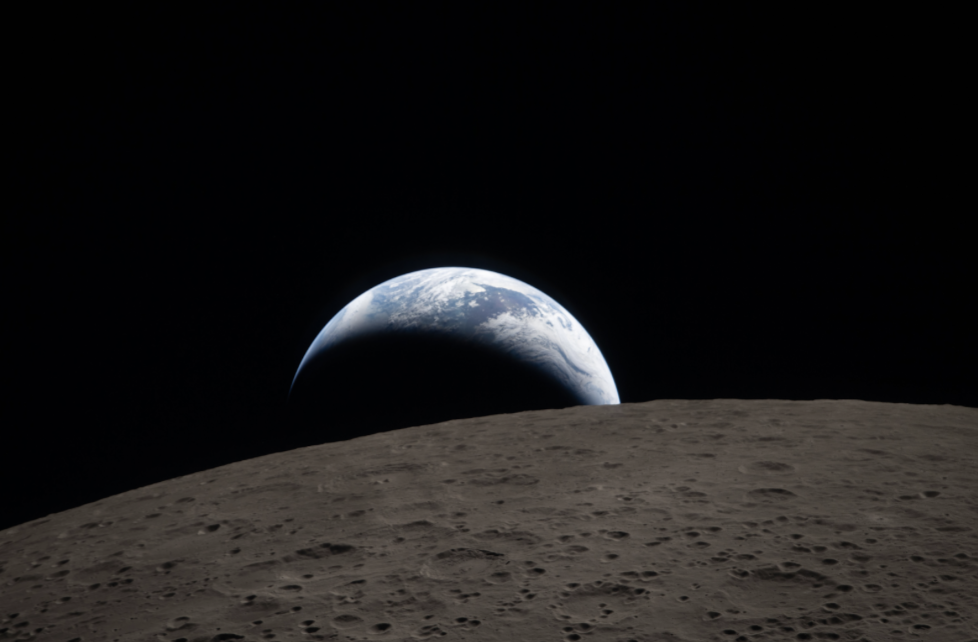
On Friday, April 10, the astronauts on the Artemis II mission successfully splashed down after completing a nearly 10-day journey around the moon, marking the first crewed lunar mission in over 50 years.
According to NASA, American astronauts Reid Wiseman, Victor Glover, and Christina Koch as well as Jeremy Hansen from the Canadian Space Agency embarked on this monumental voyage aboard the Orion spacecraft. Launched from Kennedy Space Center in Florida on April 1, the Orion followed a set flight trajectory towards the moon. On Day 6 of the mission, the spacecraft performed a close flyby of the moon before heading back to Earth. The Orion reentered Earth’s atmosphere on April 10, splashing down in the Pacific Ocean off the coast of San Diego.
“It’s been 50 years since the last moon mission,” freshman Chloe Reeder said. “Artemis II is very interesting because it’s the stepping stone for the next lunar missions,”
According to NASA, the Artemis missions as a whole are a continuation of the Apollo missions from 1962-1972. This is evident in the clever naming of the Artemis program since Artemis is the twin sister of Apollo in Greek mythology. The Apollo program stands as one of the greatest achievements in U.S. space history, boasting six lunar landings and 11 crewed missions.
“The Artemis mission affirms that we have the technology to go again to the moon,” freshman Kara Wong said. “It’s cool how we’re exploring different things through Artemis.”
Though Artemis is a continuation of the Apollo missions, the program has already claimed significant achievements that surpass those of Apollo. According to NASA, Artemis II in particular has had many firsts such as the first woman, person of color and Canadian on a lunar mission. These achievements are bolstered by the mission’s feats of bringing people the farthest away from Earth and the closest distance from the lunar surface. In addition to this, the astronauts had a clear view of the side of the moon never seen before by humans.
“I think one of the most important things that the Artemis missions have done is that for the very first time we sent a woman to the moon. For the very first time we sent a person of color to the moon. For the very first time we sent a non-American to the moon,” science faculty Colin Elliott said. “The idea that we are going back to the moon and doing it right, being inclusive, but also utilizing the best of who we have, I think is one of the biggest accomplishments.”
Now that the Orion has come home and Artemis II is completed, the question remains what the Artemis program has in store for the coming years. The Artemis III mission, according to NASA, will commence in 2027 and work on combining NASA technology with commercial moon landers in preparation for crewed missions to the moon’s surface. Artemis IV and V will focus on landing astronauts on the moon and even establishing a long-term lunar outpost. Ultimately, the Artemis missions have a bright future ahead, acting as precursors to space exploration for many years to come.
“I feel like Artemis is important for not only future space exploration, but we can establish a sustainable long-term presence in space,” Reeder said. “Maybe not just on the moon, but on other planets too like Mars and maybe one day even outside the solar system.”