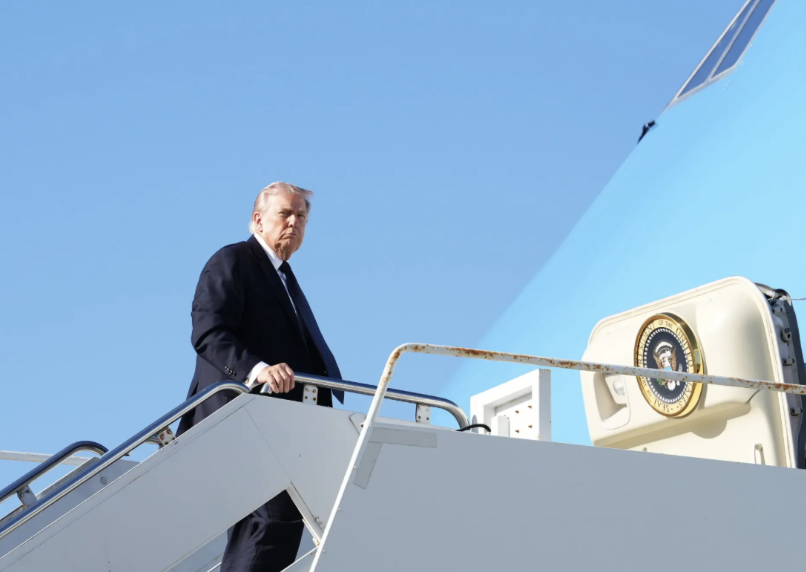
On Sunday, President Donald Trump said that the United States intends to continue its military assault on Iran for four to five weeks if necessary, signaling a potentially prolonged and dangerous escalation of conflict in the Middle East. In a brief phone interview with The New York Times, Trump expressed confidence in America’s military strength while also acknowledging that more U.S. casualties are expected.
The conflict began just 36 hours before the interview and has already resulted in American deaths. Trump admitted that projections from the Pentagon show casualties could rise, yet proclaimed that the U.S. had the ammunition to continue the assaults.
“It’s scary that he’s already talking about weeks of fighting,” sophomore Nataile Huerta Gomez said. “That makes it feel less like a quick strike and more like a full war,”
Beyond the battlefield, uncertainty surrounds what comes next for Iran’s government. Following the targeted killing of Iran’s supreme leader, Ayatollah Ali Khamenei, Trump suggested multiple and sometimes conflicting possibilities for transferring power. At one point, he referenced a strategy similar to the U.S. operation in Venezuela, where only the top leader was removed and much of the existing government remained in place.
Just as the recent Venezuelan conflict sparked controversy, so has this war. Students at Convent & Stuart Hall expressed mixed reactions to the announcement.
Junior Anya Abrahman questioned the uncertainty surrounding Iran’s leadership. “It doesn’t sound like there’s a clear plan for what happens after,” she said. “If you remove a leader without knowing who’s next, that can create chaos.”
Trump also stated he would consider lifting sanctions if Iran’s new leadership proved willing to work with the United States. Still, he declined to commit to defending Iranian citizens if they attempted to overthrow their government. The strikes have reportedly weakened Iran’s military, with U.S. and Israeli forces killing several top commanders and destroying parts of the Iranian navy. With these successes, Trump insisted the U.S. is ahead of schedule in terms of his war plans in Iran.
For many students, the situation raises broader questions about America’s role in global conflicts. After an age of relative peace following the American force’s retreat from Afghanistan, the U.S. has again been abruptly thrust into war.
“Military power isn’t the same thing as political stability,” history faculty Pete Valceschini said. “Even if the U.S. wins militarily, rebuilding a country or changing a government is way more complicated. Conflict is one of the worst ways to solve a political issue, but often necessary.”
As the assault continues, the coming weeks will determine not only the outcome of the military campaign but also whether a stable government can emerge in Tehran. With rising casualties and no fully defined transition plan, the conflict could reshape both Iran’s future and America’s role in the region.
“Whenever the U.S. gets involved in changing another country’s government, it can have consequences for decades,” Gomez said. “It’s not just about the next few weeks of fighting. War has an effect on everyone, in every country.”