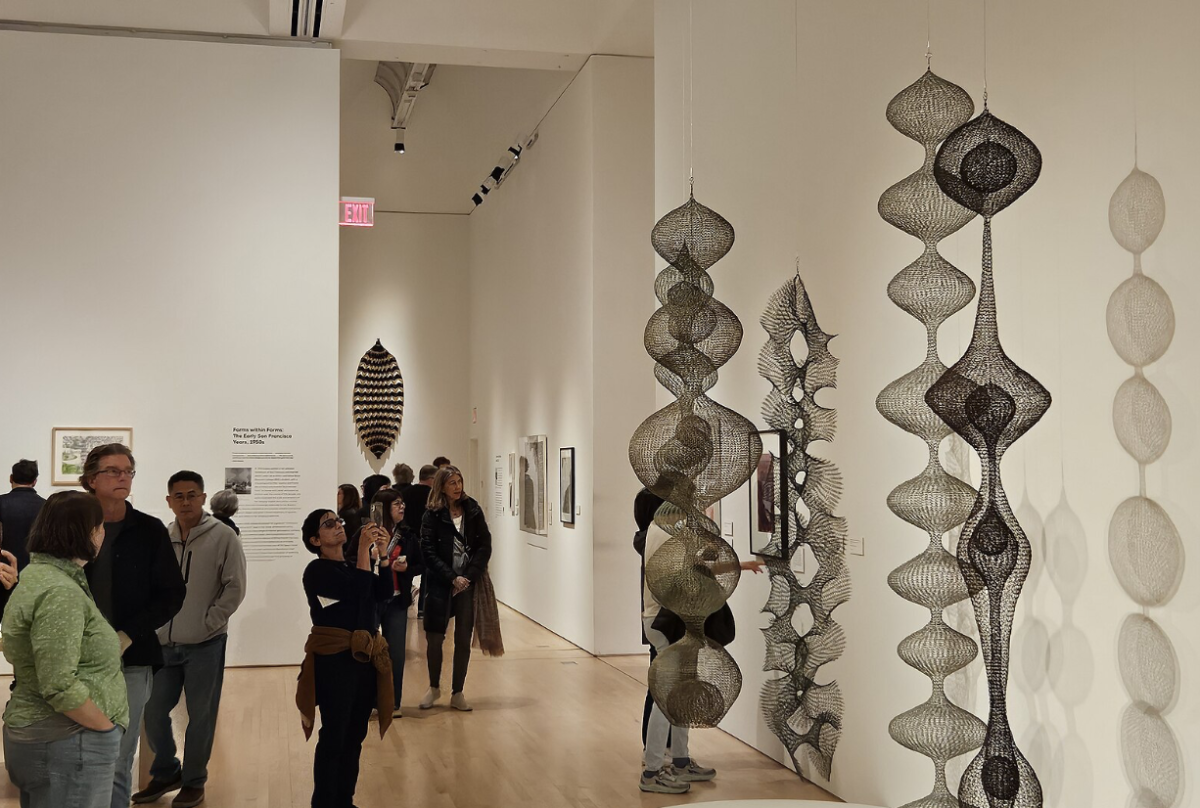
Ruth Asawa was an individual who experienced every aspect of life, and her work is an unexplainable representation of the life she lived. Her current exhibition at the SF MoMa, Ruth Asawa: A Retrospective encapsulates the diversity of her six-decade-long career using a collection of three hundred artworks to display how art and life are coexisting and eternal, enduring through modern hardship.
Asawa was the child of Japanese immigrants living in California, and was placed in an internment camp during World War II, according to Ruth Asawa.com. She later planned to study painting, but was guided towards the path of sculpture, spending a summer in Toluca, Mexico and developing her signature crochet-wiring technique. Though honored throughout her lifetime, her abstract sculptures continue to be recognized in the modern world of art, and her current exhibition at the SF MoMa has been a crucial element to her everlasting impact.
“The next generations should take inspiration from Ruth Asawa’s work and be encouraged to incorporate art into our daily lives,” sophomore Sophie Izadpanah said. “Continuing to be influences to experience and think will broaden our creativity and carry on Asawa’s legacy,”
While the impact of her work is undeniable, the ability to continue making novel forms of art is an underlying concern. Asawa’s art is a symbol of individuality and deep thought that integrates the practices of many communities to create beauty and its legacy is everlasting. But it does bring about the question of how the world can continue to bring about contemporary concepts. If there is a current lack of interest in variety and a fear of breaking from the norm, is there any hope for the next generation to keep ingenuity alive?
Addressing the relevance of art in a world of AI and technology is a task in itself. Deciphering how much novel machinery can be incorporated into art before it is no longer considered art is something the modern world is forced to grapple with, and a multitude of stances can be taken on the matter.
“AI could not have created the unique and organic nature of Asawa’s art,” art teacher Julie Martin said. “AI will never be capable of creating such unique forms, making Asawa proof that technology will never be able to replace the unbounded creativity of human beings.”
Ruth Asawa used many mediums to create her work, incorporating wire sculpture, paintings, prints, drawings, bronze casts and public works into her vast portfolio. The development of her life is reflected through the abstraction and contemporary nature of her subject matter, and it was out of pain as well as growth. Despite the relatability of her inspiration, it is clear that the modern world has begun to see art as irrelevant, as seen through articles such as The Brooklyn Rail.
“The work of Ruth Asawa is based around her experiences, and there is no way that experience could be replaced by growing technology,” senior Franchesca Lauterbach said. “If anything, art and science will develop together, and new understandings of what art is will arise.”
Despite the many controversies around art’s everdeveloping role in modern society, Ruth Asawa’s decades of work continue to serve as nourishment and hope for art’s diversity and innovation during times of increased hardship. Ruth Asawa: A Retrospective not only represents the harmony of human life and artistic flourishing, but displays the beauty of a life laced with creativity.
“Ruth Asawa inspires the youth to continue using art to recognize their individualities,” Izadpanah said. “She inspires us to travel and bring up new experiences that cause unique art for generations to come.”